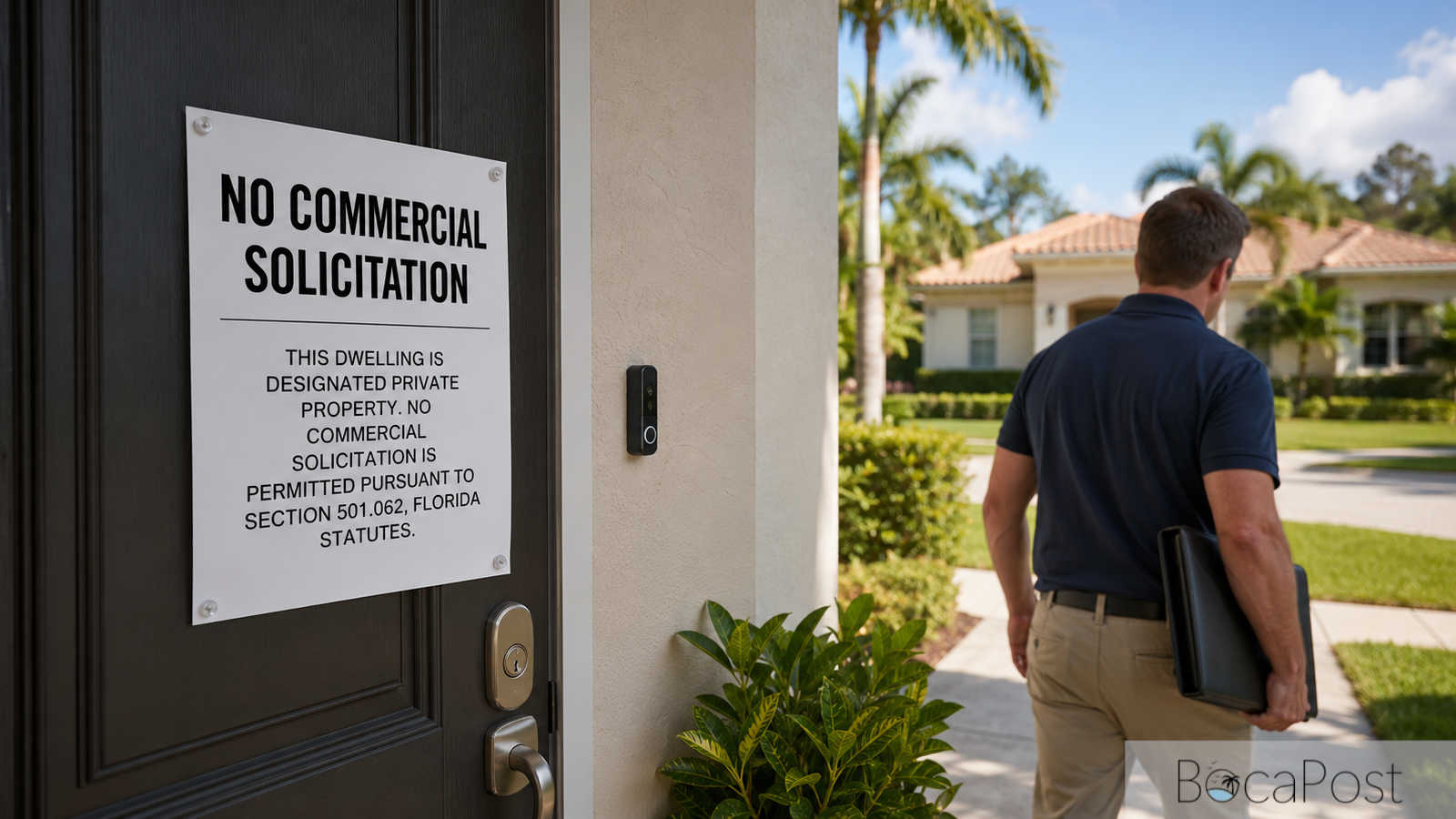
BOCA RATON, FL — A single sheet of paper by the front door now carries the weight of state law.
As of July 1, 2026, Florida homeowners can post a sign that legally bars door-to-door salespeople from their property, and the people who ignore it can be fined. The change comes from Section 501.062 of the Florida Statutes, a new consumer-protection measure that applies statewide, including across Palm Beach County, Broward County and the rest of South Florida.
The rule is straightforward. Under the law, a person may not engage in commercial solicitation at a home that clearly displays a compliant “No Commercial Solicitation” sign. Someone who does can face a $500 noncriminal fine for a first violation. A second or later violation becomes a second-degree misdemeanor.
For homeowners tired of unannounced sales pitches for roofing, solar, pest control or home security, the practical takeaway is simple: the sign only works if it meets the state’s specifications.
According to the law, the sign must be at least 8.5 inches by 11 inches, the size of a standard sheet of paper, and clearly visible to anyone approaching the home. It must carry specific wording, in letters at least 1 inch high: “THIS DWELLING IS DESIGNATED PRIVATE PROPERTY. NO COMMERCIAL SOLICITATION IS PERMITTED PURSUANT TO SECTION 501.062, FLORIDA STATUTES.” Substantially similar language is allowed.
What counts as commercial solicitation matters here. The law generally covers in-person attempts to sell or promote goods or services at a residence, such as door-to-door sales. It does not cover solicitations for religious, charitable or political purposes, which are not defined as commercial solicitation under the statute.
The measure sits alongside a separate requirement that already applies to door-to-door sales in Florida. Unless a statutory exemption applies, anyone conducting door-to-door sales at a home must hold a valid Home Solicitation Permit issued by the clerk of the circuit court in the county where the solicitation takes place. In Palm Beach County, that permit costs $100, according to the Palm Beach County Clerk of the Circuit Court and Comptroller’s court-services fee schedule.
Florida’s Department of Agriculture and Consumer Services directs residents with questions to their local Clerk of the Court.
Enforcement runs through local law enforcement. Chapter 501 of the Florida Statutes provides the mechanisms for handling noncompliance, and consumers can report suspicious solicitation activity to their local police or sheriff’s office. According to the state, providing the salesperson’s name and the company name helps law enforcement act on a complaint.
What residents should know is that the protection is not automatic. Without a sign that meets the size, visibility and wording requirements, the new penalties do not apply. Homeowners who want the coverage need to post a compliant sign before the next knock at the door.
The law took effect July 1, 2026, and applies to homes across Florida.
Boca Post primarily reports Boca Raton news, but major decisions in Tallahassee are covered when they affect South Florida residents, taxpayers, schools, businesses, or local governments.