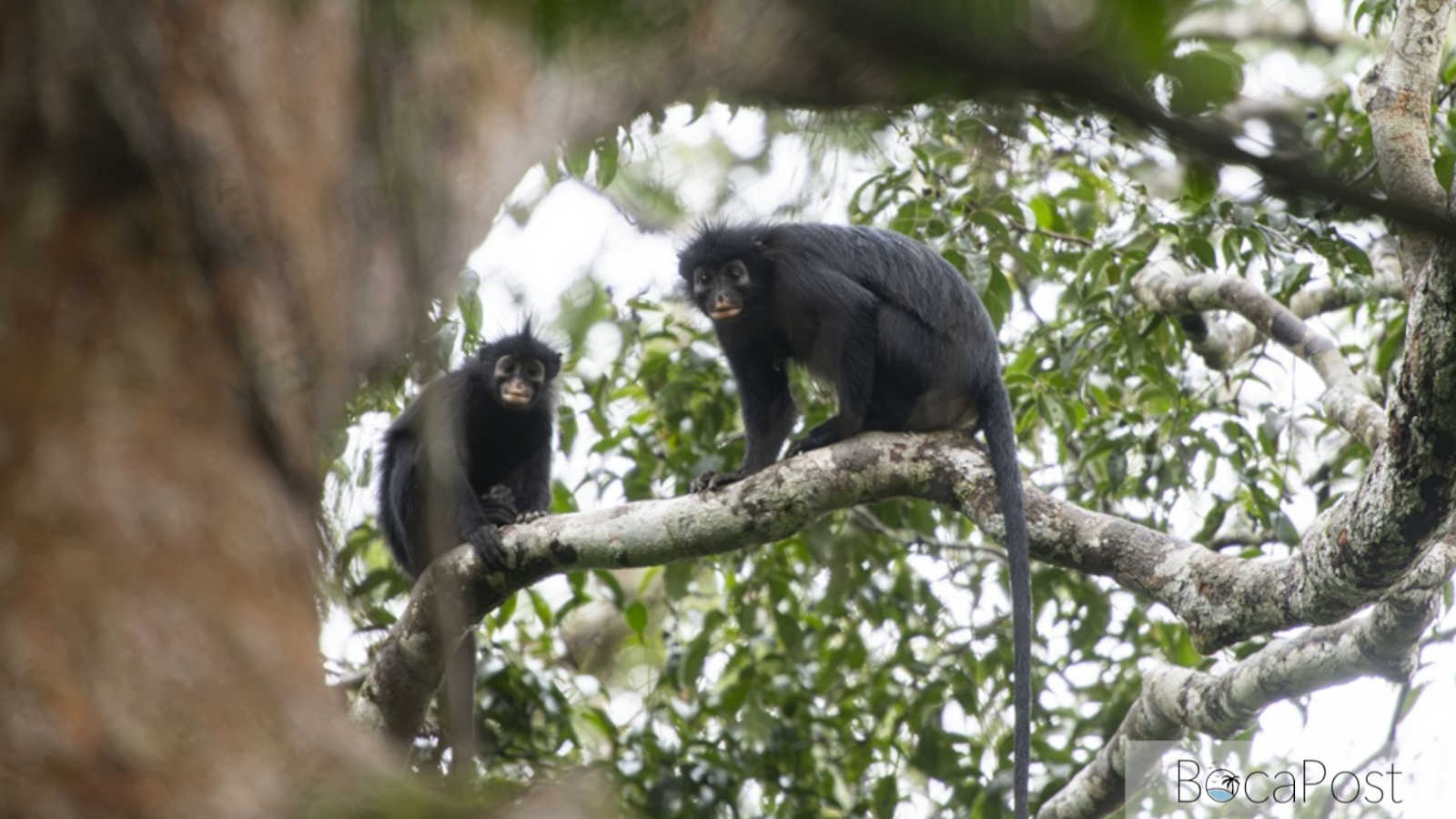
BOCA RATON, FL — A striking, mostly black monkey with vivid orange-cream lips and a mask-like face has been hiding in a remote stretch of the Congo rainforest. It took nearly two decades of research, and a team that runs through Boca Raton, to prove it was a species the world had never formally recognized.
An international team of scientists, including researchers from Florida Atlantic University's Charles E. Schmidt College of Science, has identified a previously unknown species of African monkey in the Democratic Republic of Congo, according to Florida Atlantic University. The new species has been named Colobus congoensis, and the findings are published in the peer-reviewed journal PLOS One.
The university announced the discovery on July 15, 2026. According to FAU, Colobus congoensis is only the fifth new monkey species identified in Africa in the past 75 years, making it one of the rarest finds in modern primatology.
Boca Raton-based FAU played a central role in the research. Junior Amboko, a Ph.D. student in FAU's Department of Biological Sciences and a National Geographic Explorer, is a co-corresponding author on the paper and named the species. Kate Detwiler, an associate professor of biological sciences at FAU, served as senior and corresponding author. FAU co-authors also include Emma R. Horton, a graduate of the master's program in biological sciences, and doctoral student Kathryn F. Coates.
The team also included scientists from the Lukuru Wildlife Research Foundation, Yale University, the City University of New York, and Lomami National Park and the Frankfurt Zoological Society, according to FAU.
The monkey was found in a remote area between the Lomami and Congo rivers in east-central Congo. Local communities know it as "Likweli" and also as "kasaba nkoni," which FAU says means "the branch shaker." According to FAU, only eight villages in the Lomami National Park's buffer zone recognized the animal or could accurately describe it.
Researchers first captured a partially obscured photograph of the monkey in 2008, according to FAU. A decade later, a clearer image renewed scientific interest and drove the years of genetic, anatomical and acoustic work that led to the formal description of the species.
Genetic analyses confirmed the animal belongs to the genus Colobus, according to FAU. But the closest known relative, Colobus satanas, lives more than 1,200 kilometers away in west-central Africa. Detwiler said in the FAU release that genetic evidence shows the two species diverged roughly 4 to 5 million years ago, which she described as one of the oldest known evolutionary splits within the Colobus lineage.
Anatomical and acoustic work backed up the genetic findings, according to the announcement. Researchers compared skulls and pelts against museum collections at the Yale Peabody Museum and the American Museum of Natural History. Christopher Gilbert, a co-author and anthropology professor with the City University of New York Graduate Center and Hunter College, said in the release that the comparative data allowed the team to "pretty quickly and conclusively" confirm C. congoensis as a new species. FAU said the monkey's deep, resonant roaring calls resemble those of related Colobus species but have their own distinct acoustic structure.
FAU describes the animal as smaller than related colobus monkeys, weighing about 15 pounds, with glossy black fur, cape-like shoulders, a long sweeping tail and a vivid orange-cream patch around the mouth and nose. White markings behind the tail further distinguish it, the university said.
The find is not the first significant primate discovery to come out of Lomami National Park. According to FAU, several members of this research team were also involved in the 2012 discovery of the Lesula (Cercopithecus lomamiensis) in the same region.
The scientific breakthrough comes with a warning, according to FAU. Between 2018 and 2022, researchers recorded 114 sightings of the new monkey across an estimated range of just 1,700 square kilometers, an unusually small range for a colobus species. Because of that limited range, small population size, growing hunting pressure and habitat loss, the research team is proposing that Colobus congoensis be classified as Endangered on the International Union for Conservation of Nature Red List, FAU said. Most of its known habitat lies inside Lomami National Park.
In the FAU release, Detwiler called the discovery "both a scientific triumph and a sobering reminder that some of Earth's rarest creatures may vanish before the world even knows they exist."
Amboko, who named the species, said in the release that he wanted to emphasize the animal's country of origin and that he believes it is the first primate species named after the Democratic Republic of Congo itself.
More from our Boca Raton newsroom with continuing coverage of the stories shaping the city.