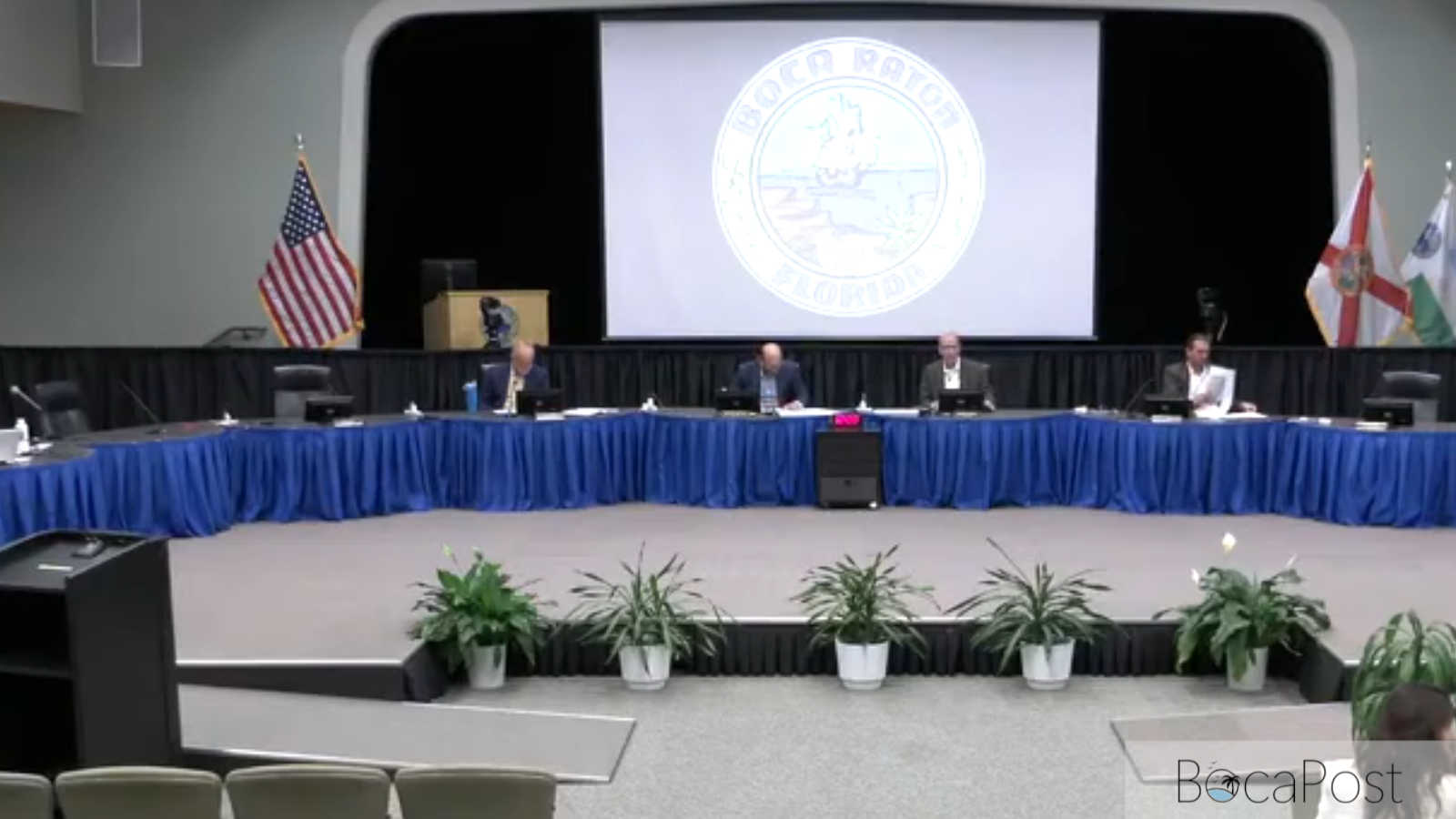
BOCA RATON, Fla. — The city's Planning and Zoning Board approved a variance July 16 allowing a fence to stand as high as 10.3 feet along the north property line of a barrier island condominium at 900 Lago Mar Lane, more than four feet above the six-foot maximum set in the city code.
The 4-0 vote resolved a compliance dispute that had held up final approvals for a three-unit condominium building whose buyers had pending contracts but could not close. Board members and staff also flagged the case as a recurring problem tied to FEMA flood-elevation requirements, and asked the city to look at whether similar variances should be handled administratively.
Zoning Manager Tori Boone said the elevation difference along the north property line, not the fence itself, drove the request. The property sits at a higher grade than the vacant lot to the north, and the city's fence code requires height to be measured from the lowest adjacent grade within three feet of either side, which pushed the effective height above the six-foot limit.
"The property's existing higher elevation complies with FEMA flood zone risk mitigation requirements, and the retaining wall was already in place before the condominium building was developed," Boone said, adding that only minor grade adjustments were made during construction of the condominium.
The property, a 0.35-acre R-5 Multi-Family Residential parcel south of Northeast 24th Street and east of the Intracoastal Waterway, was elevated to meet FEMA AE-6 flood zone standards during construction of the three-story, three-unit building. According to the staff report, the strict application of the fence code would leave the fence measuring roughly 2 to 3 feet from the property side, a height staff said would fall below Florida Building Code guard-rail requirements. The Florida Building Code requires a 42-inch guard on walking surfaces with a grade change of 30 inches or more, and the property has a grade change of approximately four feet along the northern line.
The board's approval was tied to a specific condition intended to prevent the variance from becoming permanent. Under the resolution:
- The fence height is measured from the existing grade of the adjacent lot, based on an elevation survey dated May 1, 2026.
- If the neighboring lot's grade is later raised, the fence height cannot be increased to match.
- The variance is set to expire 18 months from the date of adoption if a replacement building permit reflecting the actual fence height is not issued.
Boone said the condition would cause the wall to fall within code on both sides once the adjacent lot is redeveloped and raised to FEMA elevation standards.
Attorney David Milich, representing owner Lago Mar Crossings, LLC, told the board the situation is "essentially the drop off" between the higher property and the lower neighboring lot, and framed the request as a possible short-term fix. "This could potentially be just a temporary variance," Milich said. "Whenever that property to the north redevelops, it's going to have to meet its own elevation requirements."
The lone member of the public to speak, Dean Paul, said he lives at 955 Lago Mar Lane and was speaking on behalf of the Lago Mar homeowners association. "We are all in support of this," Paul said. "It does not adversely affect any of us." The staff report noted the applicant also submitted written letters of support from the owners of the adjacent properties to the north and east.
Board members used the item to press staff on whether cases like this should keep landing in front of the board at all. Secretary Gregory Mitchell asked whether variances driven by FEMA fill rules could be routed to administrative approval instead of a monthslong hearing process.
"For all the variances we grant for someone who has to raise their lot by law, we then have to tell them, okay, you have to come before us because you had to build a fence," Mitchell said. "Is there any way we could have that administratively approved? How could you not give them a fence?"
Staff acknowledged the issue is under review but told the board a blanket administrative fix is not straightforward. From the neighbor's perspective, staff said, an unchecked variance could leave someone facing a 10-foot fence, so the code has to balance those interests.
Chair Arnold Sevell noted that the applicant had already been issued a fence permit in July 2025 for a six-foot fence, and the compliance problem surfaced later. "They got a permit, but they didn't build to plan," Sevell said. Vice Chair Timothy Dornblaser and board member Jorge Camejo also voted in favor. Members Les Matthews, Harry Mirabile and Chaim Morgan were absent.
The vote is the board's final action on the fence height variance. The larger three-unit condominium building was previously approved by the Planning and Zoning Board in 2016 and permitted in 2022. Board members said they expect the fence-height issue to fall within code on its own once the adjacent lot to the north is redeveloped and raised to FEMA-compliant elevation.
The 900 Lago Mar variance is one of several recent cases in which board members have said FEMA base flood elevation requirements, adopted for storm-surge and flood risk mitigation, are producing sharp grade differences between adjacent lots that were built or raised at different times. Staff told the board the issue reaches beyond fences and is being reviewed by the city.
As reported by Boca Post, the July 16, 2026, Planning and Zoning Board meeting also included a vote on the 1000 North Federal Highway furniture showroom, the median beautification fee reduction, and the 1150 Innovation Center setback variance.
Stay informed on zoning proposals, City Council decisions, and major development projects shaping Boca Raton. Visit our Boca Raton City Government and Development page for ongoing coverage from City Hall and planning meetings.