DELRAY BEACH, FL — A 2012 ethics letter is back in focus in Delray Beach.
The issue centers on Mayor Thomas Carney, a proposed 47-unit luxury townhome project on North Federal Highway, and competing local newsletters that are arguing over whether Carney’s contact with Planning and Zoning Board members crossed a line or stayed within guidance he received years ago.
The project, described in the newsletters as Ultra Luxury Townhomes, is proposed for North Federal Highway near Gulfstream Boulevard. According to the materials reviewed by Boca Post, the project went before the Delray Beach Planning and Zoning Board in May and received unanimous approval from the board.
The dispute is not over whether the project has reached final city approval. The materials provided say it still needs to go before the Delray Beach City Commission.
The fight is over what happened before the advisory board vote.
The Delray Gazette, in a May 31 email newsletter, accused Carney of contacting five of seven Planning and Zoning Board members before the vote to urge support for the development. The Gazette said Carney’s brother has a financial interest in the project and questioned whether the mayor’s involvement was appropriate.
The same newsletter said the project requested four zoning waivers and a conditional use permit because the property is in a General Commercial zoning district. According to the newsletter, all requests were unanimously approved by the Planning and Zoning Board at a quasi-judicial hearing.
A separate email newsletter, The Delray Guzzette, included what it described as Carney’s response.
That email included what it described as Carney’s direct response. In it, Carney said he has no financial interest in the project and that his brother, Peter, owns a minority interest of less than 5%.
Carney also said he previously received an ethics opinion involving a similar situation when he was vice mayor. According to the response published in The Guzzette, Carney said he spoke with some Planning and Zoning Board members and asked whether they had questions about the project. He said he did not pressure anyone or ask anyone to support it.
Carney also said the proposal will come before the City Commission and that he will recuse himself from voting.
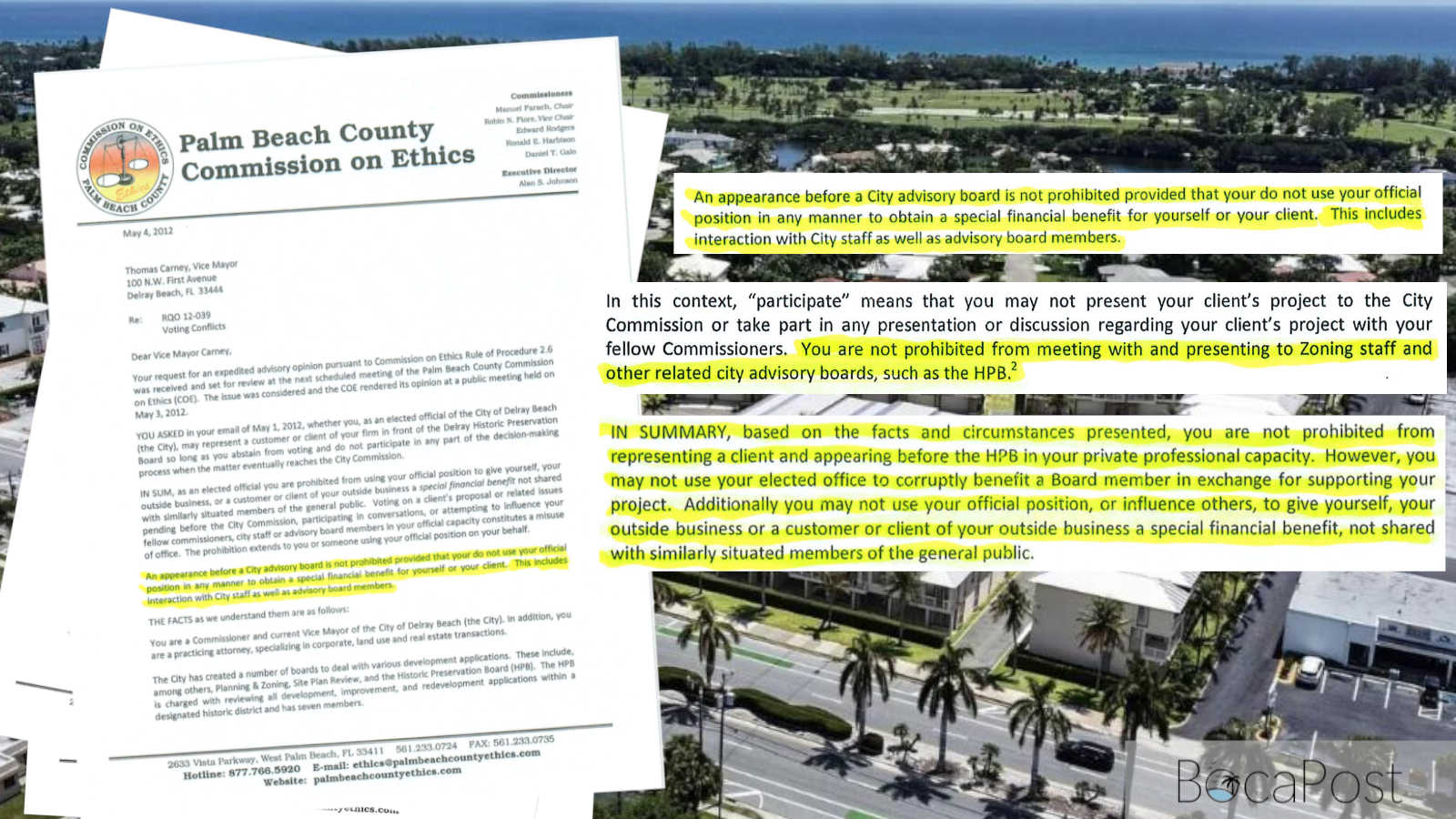
The document now at the center of the dispute is a May 4, 2012 advisory opinion from the Palm Beach County Commission on Ethics. The letter was addressed to Thomas Carney, then vice mayor of Delray Beach, and involved voting conflicts.
In that 2012 request, Carney asked whether, as an elected official, he could represent a customer or client of his firm before the Delray Historic Preservation Board as long as he abstained from voting and did not participate in the decision-making process when the matter later reached the City Commission.
The Commission on Ethics letter allowed some activity while also setting limits.
The letter said an appearance before a city advisory board was not prohibited, provided Carney did not use his official position to obtain a special financial benefit for himself or his client. The letter said that included interaction with city staff and advisory board members.
But the letter also warned that Carney could not use his elected office, official position, or influence to give himself, his outside business, or a client a special financial benefit not shared by similarly situated members of the public.
The opinion also said voting on a client’s proposal before the City Commission, participating in related conversations, or attempting to influence fellow commissioners, city staff, or advisory board members in his official capacity would constitute misuse of office.
The advisory opinion was issued in the context of Carney acting as an attorney for a client before a city advisory board. The current dispute, based on the materials provided, involves a project in which Carney says he has no financial interest, while acknowledging that his brother has a minority interest.
That distinction matters.
The 2012 opinion does not say Carney can freely use his elected position to influence advisory board members. It also does not say every advisory board contact is prohibited. Instead, it draws the line around whether the official position, title, or influence is used to obtain a special financial benefit.
The materials provided to Boca Post do not include a filed ethics complaint, a ruling from the Palm Beach County Commission on Ethics on the current townhome project, official Planning and Zoning Board minutes, or copies of communications between Carney and board members.
The two newsletters framed the issue differently. The Gazette framed the issue as an ethics concern involving the mayor, his brother, and the project’s path through the advisory board. The Guzzette framed the criticism as political and said Carney acted in good faith under the 2012 ethics opinion.
For Delray Beach residents, the practical question is what happens next.
Based on the materials reviewed, the project still must go before the City Commission. Carney has said he will recuse himself from that vote. What remains unclear from the provided records is whether any ethics complaint has been filed over the current project or whether the Palm Beach County Commission on Ethics has been asked to review the new facts.