
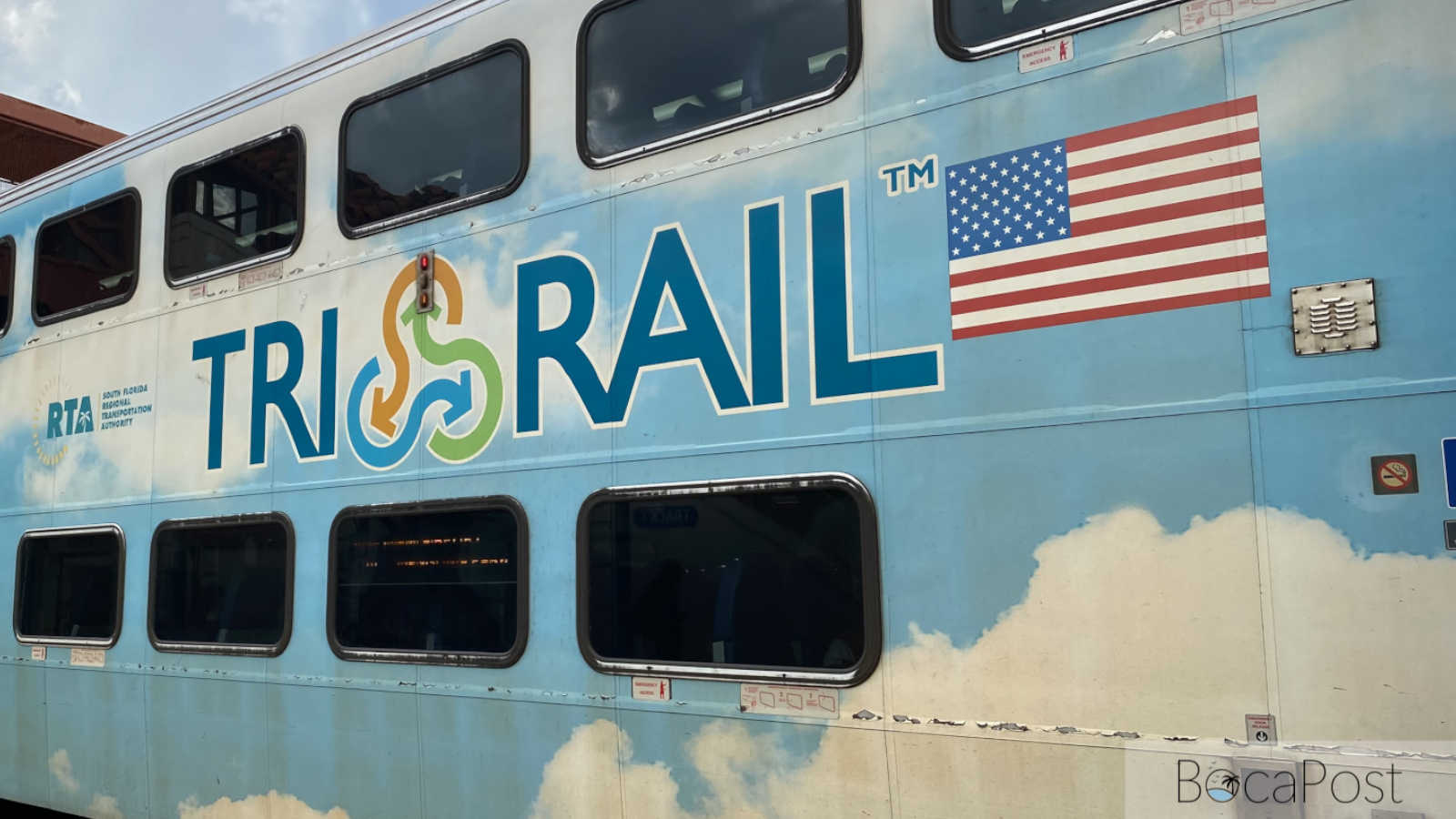

PALM BEACH COUNTY, FL (Boca Post) (Copyright © 2026) — Tri-Rail set another ridership record in 2025, topping 4.5 million rides in the calendar year and surpassing the previous all-time mark set in 2019, the South Florida Regional Transportation Authority announced.
For Palm Beach County riders, that matters because Tri-Rail is one of the few regional transportation options that runs beyond city borders and county lines, linking stations in Palm Beach County to Broward and Miami-Dade. When it’s working and people use it, it takes pressure off the same corridors that locals rely on every day—especially I-95 and the parallel roads that back up when there’s a crash, construction, or the usual rush-hour grind.
The South Florida Regional Transportation Authority, which oversees Tri-Rail, said the 2025 calendar-year total topped 4.5 million rides and established a new record for the system. The authority said the milestone also follows Tri-Rail’s fiscal-year performance—July 2024 through June 2025—which also surpassed 4.5 million rides.
That’s notable because it means the system hit a similar threshold across two different counting windows: the fiscal year used for budgeting and planning, and the calendar year most riders think in. The authority said Tri-Rail’s new performance exceeds its previous record set in 2019, when the system surpassed 4.4 million rides in both the fiscal and calendar years.
Palm Beach County Vice Mayor Marci Woodward, who chairs the SFRTA Governing Board, framed the new numbers as proof the service is being used and should be protected.
“We were not kidding when we said last year that we planned to keep breaking our own records,” Woodward said. “The value of this system speaks for itself, and it shows that more than ever we must continue to protect this essential service, which serves as a critical asset for the region.”
SFRTA also pointed to momentum leading into the record year. Tri-Rail ended calendar year 2024 with what the authority described as its second-highest ridership total, underscoring what it called the system’s continued role for a mix of daily commuters and seasonal and leisure riders. In South Florida, where traffic patterns shift with tourism and winter season, that blend can be a real driver of ridership swings.
SFRTA Executive Director David Dech credited riders directly and said the agency intends to keep improving the service.
“Our passengers are the lifeblood of this system and we are deeply grateful for their continued support,” Dech said. “We will repay that trust by continuing to enhance the service in every way possible and try to provide the best possible travel experience that South Florida deserves.”
The authority tied some of the year’s visibility to special-event service and to major events ahead. It said Tri-Rail began the year by offering New Year’s Special Service, including post-midnight train service for people celebrating at Bayfront.
Looking forward, SFRTA said the system is positioned in 2026 to serve spectators attending events at Miami Freedom Park, which the authority said is inaugurating this year. The authority also said Tri-Rail is a key partner in Miami-Dade County’s transportation committee for the FIFA World Cup and is preparing to help move people to World Cup matches and Fan Festival activities.
Regionally, transportation officials often describe Tri-Rail as the equivalent of adding a lane on I-95—a way to move more people without widening the highway. SFRTA described Tri-Rail as a cornerstone of mobility in South Florida, saying the system helps relieve roadway congestion, connect communities, and support regional economic growth. The authority also described Tri-Rail as the “multimodal backbone” of the region, linking passengers into a broader network of transportation systems across three counties and dozens of municipalities.
For riders in Palm Beach County, the record is a snapshot of demand: more people are choosing—or needing—a reliable option that avoids the worst stretches of traffic. For the agencies that fund and operate the system, it’s a marker they will point to as decisions get made about service levels, coordination with other transit, and how the region handles big-event travel when South Florida fills up.
Source: South Florida Regional Transportation Authority (SFRTA) announcement


0 Comments