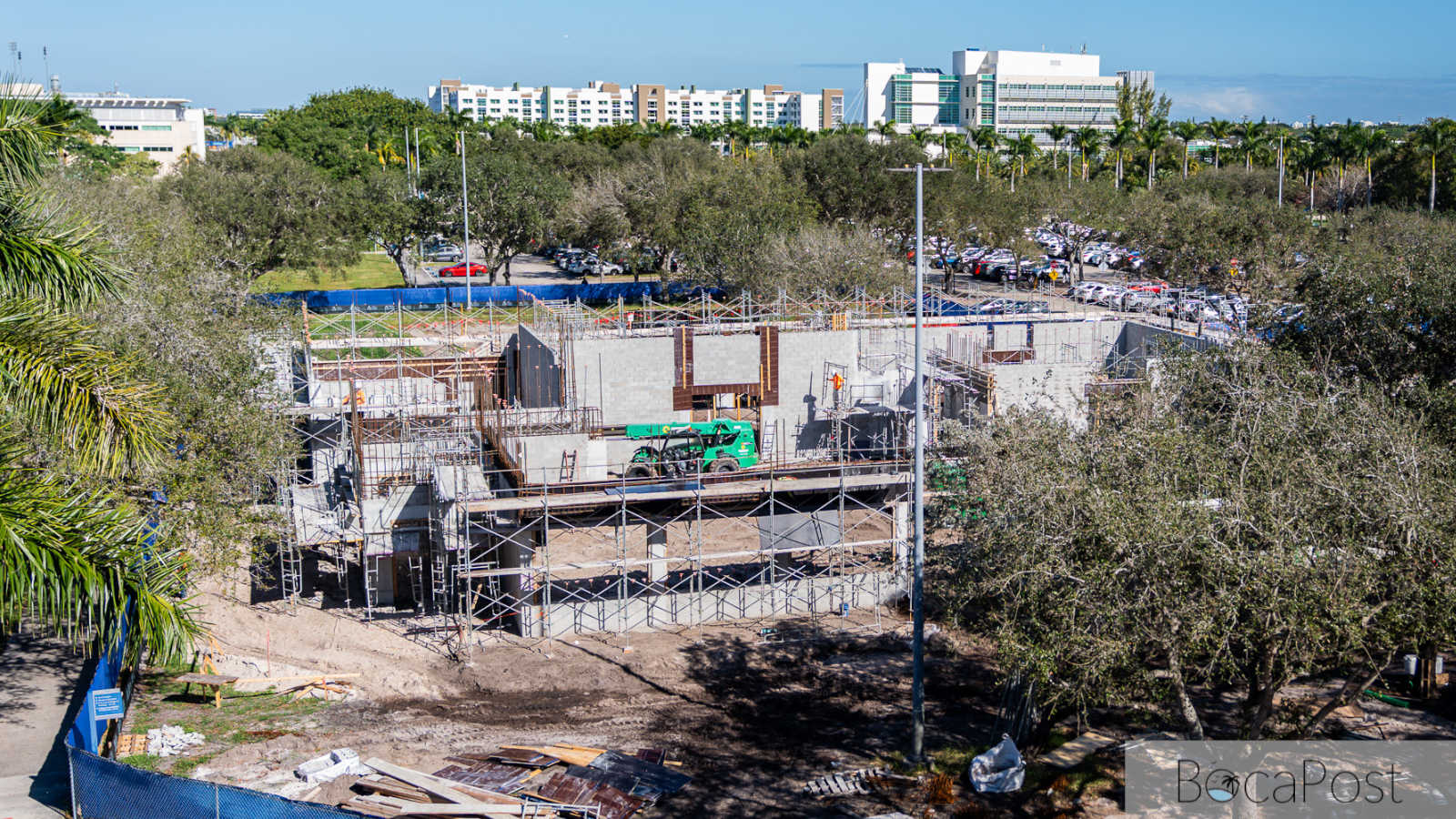
BOCA RATON, FL — Construction is underway on Florida Atlantic University’s Kurt and Marilyn Wallach Holocaust and Jewish Studies Building, a 22,000-square-foot, two-story facility planned as the home for FAU’s Holocaust education, Jewish studies, and related programs on the university’s Boca Raton campus.
University materials describe the building as both an academic hub and a public destination, designed to bring together teaching, research, and community engagement focused on the Holocaust, Jewish studies, human rights education, and leadership training. The goal, according to the project description, is to create a place where students, educators, and visitors can engage directly with lessons rooted in history and apply them to contemporary challenges tied to intolerance, antisemitism, racism, and other forms of hate.
The building is named for Kurt and Marilyn Wallach, whose philanthropic gift established the Kurt and Marilyn Wallach Institute for Holocaust and Jewish Studies, with a portion serving as the lead gift toward construction of the new facility. Project materials describe Kurt Wallach’s personal connection to Holocaust history, noting that his childhood included fleeing with his family to escape the Nazis, and that more than 200 of his family members were killed during the Holocaust. In a quoted statement included in the project brochure, Wallach said, “We speak for those who cannot speak. We remember all the victims, including our family members who perished needlessly. No one should ever be subjected to such horror.”
Kurt Wallach died in 2021 at age 95, less than a year after he and his wife, Marilyn, made a $20 million gift to Florida Atlantic University, the largest in the school’s history. The donation established the Kurt and Marilyn Wallach Institute for Holocaust and Jewish Studies and provided funding for a permanent building on FAU’s Boca Raton campus dedicated to Holocaust education, Jewish studies, and human rights programming.
FAU’s plan for the building centers on dedicated spaces intended to support both formal instruction and broader public programming. The project brochure outlines a state-of-the-art recital and lecture hall planned at 2,700 square feet with seating for 150. The hall is described as a venue for music performances, public lectures, film screenings, literary talks, cultural events, and academic use, including student recitals tied to FAU’s Department of Music.
The brochure also describes a traveling exhibition hall planned as a secure, 1,950-square-foot gallery space for rotating exhibits. Materials state the space is intended to host traveling exhibits from major institutions, including the United States Holocaust Memorial Museum and Yad Vashem, along with other organizations, with themes spanning Holocaust and Jewish studies as well as programming connected to peace, nonviolence, and diplomacy.
A central feature described in the plans is the Craig and Barbara Weiner Holocaust Museum of South Florida at Florida Atlantic University, a 2,000-square-foot museum space intended to serve as a permanent home for Holocaust artifacts donated for educational use. The brochure states the museum will include historical artifacts and will support an educational outreach program for middle and high school students, with an emphasis on bringing students to the museum as part of broader Holocaust and human rights education efforts.
Another planned component is the George and Irina Schaeffer Dimensions in Testimony interactive display, described as a technology-driven installation that allows visitors to ask questions and receive real-time, pre-recorded responses from survivors and other witnesses to genocide. Project materials state the display was developed through the USC Shoah Foundation and is designed to preserve first-hand accounts in a way that enables interactive dialogue for future audiences.
The building’s design also includes an outdoor memorial element. The brochure describes the Marta and Jim Batmasian Memorial Pavilion as a lakeside space adjacent to the building intended for quiet reflection and gatherings, positioned as a visible and accessible feature connected to the building’s purpose.
FAU materials place the Wallach Building within the university’s broader structure of related programs, including Holocaust and Jewish studies offerings, human rights education, and the Center for Peace, Justice and Human Rights. The brochure also references the Leon Charney Diplomacy Program and describes collaborations linked to the Florida-Israel Institute, a state-created initiative aimed at strengthening ties between Florida and Israel through academic and cultural relationships.
As construction advances, university materials frame the building as a long-term anchor for education and public engagement in Boca Raton and the greater South Florida region, with a focus on preserving survivor testimony, presenting historical artifacts, and expanding opportunities for lectures, exhibits, and cultural programming tied to the building’s mission.
Learn more about the Wallach Building and Programs.