
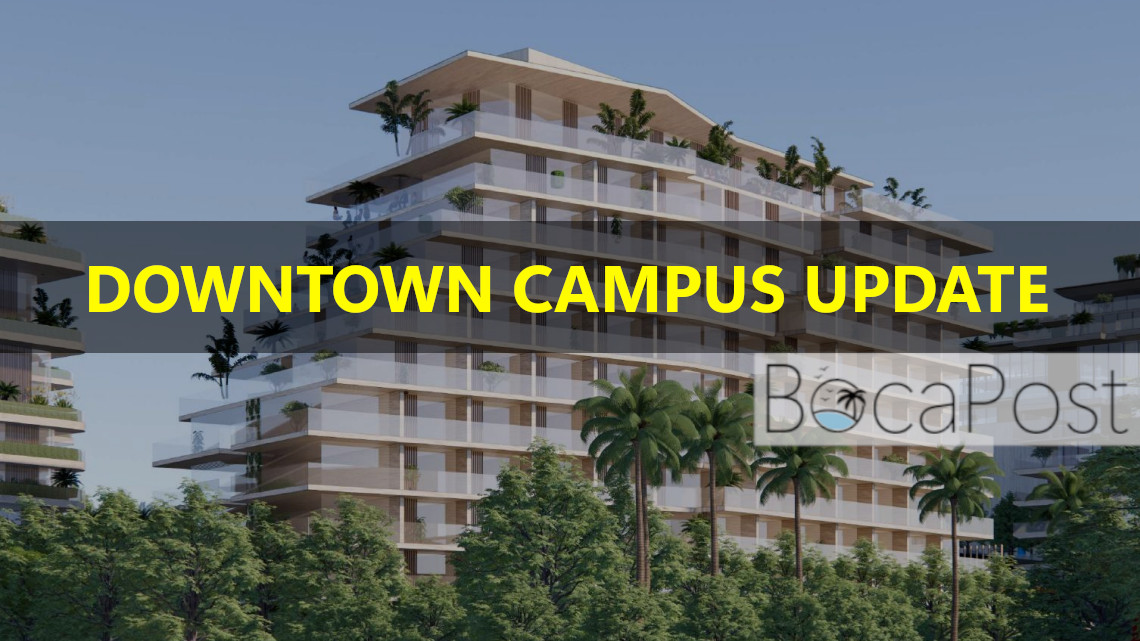
One Boca Now Eying El Rio Trail.
Boca Post is tracking the Downtown Campus Redevelopment Project, one of the most significant civic initiatives currently under consideration in Boca Raton.
BOCA RATON, FL (Boca Post) (Copyright © 2025) — While the One Boca proposal continues to move through the city’s approval process, a separate legal fight over voter control of public land decisions is unfolding in court, setting up two tracks that could shape Boca Raton’s downtown future in the months ahead.
Last week, the city’s Planning & Zoning Board unanimously voted to recommend approval of a 99-year ground lease tied to the One Boca proposal, clearing the way for upcoming City Council action. The proposed lease covers approximately 7.8 acres of city-owned land east of Northwest 2nd Avenue, near the Brightline station, and is a key component of the broader Downtown Campus plan.
“This marks a major milestone,” One Boca said in its latest update, calling the project a chance to build a “true downtown destination where residents can live, work, shop and gather.”
Rob Frisbie, managing partner of the Frisbie Group and a co-developer of One Boca, praised the board’s action and said the team plans to keep engaging with residents as the proposal moves through the public process.
“We are thankful for the Planning and Zoning board’s leadership on the One Boca proposal and recommending approval to the City Council,” Frisbie said. “The One Boca proposal will be instrumental for Boca Raton’s future, creating a true sense of place and purpose. We are committed to working with the community as the proposal continues.”
According to project updates released by the One Boca team, the proposal is intended to preserve Memorial Park, modernize civic buildings and infrastructure, and expand usable public recreation space downtown. The developers also said they are exploring an extension of the El Rio Trail into the government campus area. The developers say public engagement will continue as the project advances, with City Council scheduled to vote on the Master Plan Agreement on Jan. 6 and Jan. 20. If approved, the framework would then go before voters on March 10.
At the same time, a lawsuit involving the citizen-led Save Boca initiative remains active in Palm Beach County Circuit Court.
On Dec. 19, organizers behind the Save Boca referendum effort filed an emergency motion asking the court to vacate a prior order that temporarily blocked two voter-initiated measures from appearing on the ballot. The filing seeks to undo a Dec. 1 order that granted a temporary injunction and removed the proposed charter amendment and ordinance from a planned Jan. 13, 2026 special election.
The Save Boca measures, backed by petition drives that organizers say collected more than the required number of voter signatures, are designed to require voter approval before certain city-owned land can be sold, leased, or otherwise conveyed. Supporters argue the measures would prevent future decisions involving public land from being made without direct voter consent.
In the emergency motion, Save Boca organizers and petition committees argue that the injunction should be lifted for both procedural and legal reasons. They contend that key parties — including the petition sponsors themselves — were dismissed from the case before the court ruled on the injunction, even though the decision directly affected their rights. The filing also argues that controlling appellate case law supporting voter referendums on public land was not presented to the court at the time of the initial ruling.
The motion further claims that the lawsuit challenging the referendum was improperly refiled in a different court division after a voluntary dismissal, without proper disclosure to the clerk, and that state law allows charter amendments to go to the ballot even if city charter timing requirements are not met.
The court has not yet ruled on the emergency motion. Until it does, the injunction remains in place, keeping the Save Boca questions off the ballot for now.
The legal dispute adds another layer of uncertainty as the One Boca proposal heads toward critical decision points. While the One Boca ground lease recommendation does not itself finalize the project, it represents a significant procedural step, with City Council action and a citywide vote now clearly on the calendar.
Supporters of One Boca have emphasized that Memorial Park would remain city-owned and that public recreation space would increase under the proposal, including new green space east of Northwest 2nd Avenue and potential extensions of existing trails. Critics and Save Boca supporters, meanwhile, continue to frame the issue as a broader question of who ultimately controls decisions involving public land.
For residents, the coming months are likely to bring a mix of council hearings, court rulings, and campaign-style messaging ahead of the March election. Whether the Save Boca measures ultimately reach the ballot — and how that outcome intersects with the One Boca timeline — remains an open question as both processes move forward.


SaveBoca.org represents the will of the overwhelming majority of Boca Raton residents. That is precisely why developers responded by creating OneBoca.com—not as a grassroots movement, but as a calculated counterweight designed to confuse voters, blunt opposition, and preserve a lucrative development pipeline.
OneBoca’s efforts have gone well beyond advocacy. Its allies have actively worked to stifle resident-led voter initiatives, most notably by claiming ballot language is “unclear”—a procedural smokescreen routinely used to block citizens from exercising their right to vote when powerful interests fear the outcome. When developers cannot win on the merits, they attempt to win by obstruction.
At the same time, while City Council publicly speaks of a “listening tour,” certain political pawns are quietly attempting to bind the City of Boca Raton to a 99-year lease with private developers—an irreversible commitment being pushed before residents have been heard and before voters are allowed to decide. This is governance in reverse: the deal first, the dialogue later. The cart has not merely been placed before the horse—it has already been hitched.
Boca Raton’s desirability is not accidental. It is the product of a deliberate, resident-driven choice to remain a low-rise coastal community, thoughtfully situated between the unchecked growth of Fort Lauderdale and West Palm Beach. For decades, thousands of residents living within miles of the ocean have enjoyed open skies and coastal breezes—benefits already being degraded by existing multi-story downtown construction.
Approving ten-story buildings—and now floating twelve—sets a clear and dangerous precedent. Every neighboring parcel becomes entitled to follow suit. While residents support reinvesting rising property values to modernize public offices and infrastructure, there is no public mandate to surrender long-term control of public land through decades-long lease entanglements that primarily benefit private developers.
A change in mayor does not change the question before us. Boca Raton must decide whether it will be governed by its residents or by developer interests operating through shell advocacy groups and insider arrangements. The choice is stark: continued, conservative growth that has preserved Boca Raton’s character and prosperity for more than a century—or permanent capture by aggressive, developer-driven expansion.