

This development is connected to the broader Downtown Campus Redevelopment Project, the City’s long-term plan to modernize its downtown government campus. For background on the proposal, the agreements approved by Council, and the referendum details, see the full project page.
BOCA RATON, FL (Boca Post) (Copyright © 2025) — What started as another Tuesday night at City Hall turned into a full-blown argument over who gets to shape Boca Raton’s civic core.
City staff and developer One Boca came armed with a slimmer plan for the Government Campus project — a plan they say cuts the private footprint to less than eight acres and leaves Memorial Park untouched west of Northwest 2nd Avenue.
The promise didn’t calm anyone. It just redrew the battlefield.
The City’s Homework
Deputy City Manager Luke Casek began with spreadsheets and next steps.
Staff, he said, is still picking through the new master plan — traffic studies, appraisals, cost models, the works.
“We just had a meeting with PFM to go over some preliminary data today,” Casek told the council, referring to the outside consultants now running a full financial review. Their task: test the numbers, the risks, the public benefit.
That was the calm part of the evening.
Developer Tries Again
When Rob Frisbie from One Boca took the microphone, he didn’t waste time. He presented the updated, scaled back “One Boca“, we previously reported on.
“There will be no private development west of Northwest 2nd Avenue in Memorial Park,” he said — a line he repeated more than once. The revision, he told the room, “protects public land, expands parks and amenities, and connects the Civic Center to the rest of downtown.”
The math changed too: 31 acres down to less than 8. All east of 2nd Avenue, all on paved ground. “We’re focusing on existing parking lots and defunct buildings, not green space,” Frisbie said.
He called the concept “community-minded,” adding that “the project will ultimately go to the voters.”
What’s Actually on the Table
Seven buildings — as of the latest update. An office by Brightline, a condo where the Color Graphics site sits, a hotel, a few mixed-use buildings in between.
Frisbie said the overall square footage dropped about 20 percent. 769 residential units, 186 condos, a 150-thousand-square-foot office, and a 180-room hotel.
He promised shorter heights near neighborhoods: 125 feet south of Fourth Street, 100 feet beside Brightline.
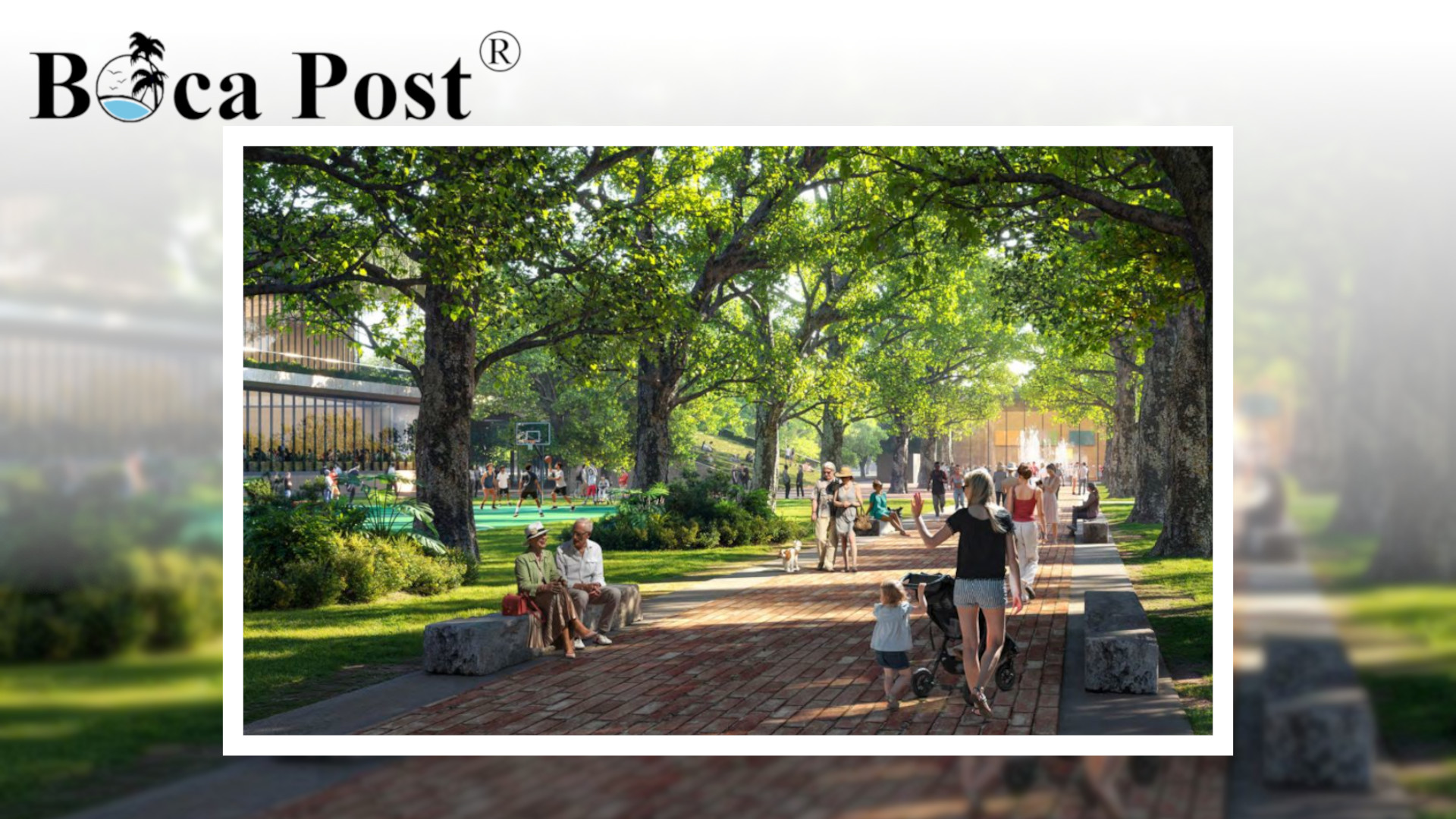
On the park side, the land stays public. Renderings showed a long central promenade, shaded paths, and a modern community center with rooftop seating. He talked about a “Banyan Village,” where the big trees stay and people could linger for coffee or lunch.
“It will be one of the most special places to spend time,” he said.
The Children’s Museum buildings stay too, with new playgrounds around them. Even the Eagle statue might move closer to Palmetto Park Road — a symbolic front door for what Frisbie called a “living memorial.”
The Money
No vote, no deal — but plenty of figures. Frisbie said early projections show $3.8 billion in gross revenue over 99 years, with a net present value of $370 million. Rent alone, he said, nets about $217 million NPV.
He circled back: “The lease area is just under eight acres.”
Voices From the Floor
That’s when the tone changed.
“We have great credit,” one man said flatly. “We don’t need a public-private [partnership]. We don’t need to sell our property to developers to do this.” He jabbed at the phrase “world-class.” “I don’t own a Bentley. I don’t own a Rolls-Royce. We can have something nice. Maybe a Lexus. Maybe a Cadillac. We don’t need to have world-class. We don’t need to spend that much money.”
A few people clapped. Others folded their arms.
Then Christina Bloker spoke. Her voice carried more exhaustion than anger.
“Last Thursday, October 23rd, my daughter fractured her hand at Memorial Park,” she said. “A routine softball drill met one of many divots in the outfield.” Bloker described five generations of her family tied to the park. She called the fields “aging infrastructure” that doesn’t preserve heritage but “limits it.”
She wanted movement, not another study.
“Safe playable fields with real drainage, accessible paths and crossings… spaces that dignify our veterans and welcome families every day,” she said. And then the line everyone remembered: “Authorize phase one, east of Northwest Second Avenue now.”
She paused before her closing thought. “We clearly all share love for the city,” she said. “Silence yields the future to the loudest voice, not the strongest plan.”
Same Story, New Meeting
By the end, nothing had really shifted — except maybe the volume.
One camp says the city should build on its own and keep total control. The other says start east of 2nd Avenue now and finally fix what’s broken.
Both claim they’re protecting Boca’s heart. Both probably are.
Staff keeps working with PFM. The developer will be back. The debate isn’t going anywhere. As previously reported by Boca Post, the people will vote in March.
0 Comments