
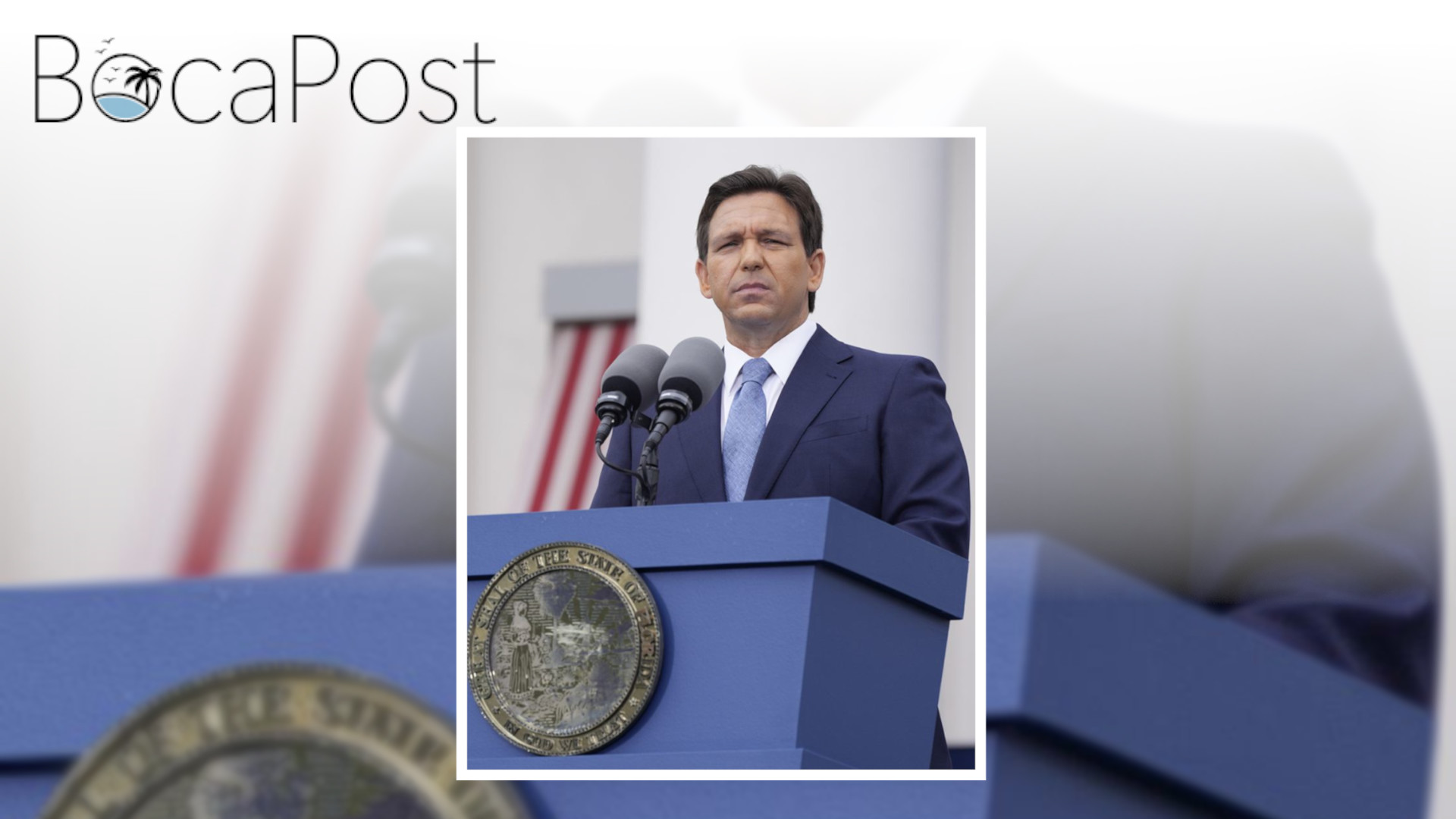
Orlando, FL (Boca Post) (Copyright © 2025) —Governor Ron DeSantis has proposed a $117.4 billion “Floridians First” budget for Fiscal Year 2026–27, a plan he says keeps Florida on a path of “fiscal responsibility” while pumping more money into schools, infrastructure, housing, and environmental projects.
Quick Takeaways
• Total Budget: $117.4B; Reserves: $16.75B; Debt: $250M paydown.
• K–12: $30.6B; Per Student: $9,406; Teacher Pay: $1.56B.
• Higher Ed: $1.9B colleges; $4B universities.
• Workforce: $800M (incl. $130M nursing).
• Transportation: $14.3B; Resurfacing: 2,622 lane miles.
• Housing: SHIP $170.8M; SAIL $72.9M; Heroes $50M.
• Law Enforcement/Corrections: 5% boosts; $28/hr starting corrections pay; 500 new positions.
• Environment: $1.4B Everglades/water; CERP $681M.
• Health: $278M cancer; $159M behavioral; $187M opioid programs.
The proposal includes $16.75 billion in reserves and $250 million for debt reduction, with an emphasis on paying down what the administration calls “legacy debt.” The budget adds another $250 million in recurring accelerated debt paydown, putting the state on track to retire more than half of its tax-supported debt in the coming fiscal year, according to the Governor’s Office.
“Since I became governor, we have run budget surpluses, reduced the state’s legacy debt by more than 50%, and enacted record tax relief,” DeSantis said in the announcement. He said the Floridians First Budget “delivers on the priorities that have made Florida the greatest state in America.”
State officials say the Budget Stabilization Fund has more than tripled during DeSantis’ two terms, rising from $1.5 billion to the constitutional maximum of $5 billion, and is fully funded again this year with an additional $118 million.
On taxes, the administration says it has delivered nearly $9.7 billion in tax relief since 2019, including a full repeal of the commercial rent tax, which it says saves small businesses $2.7 billion annually. The plan continues a mix of permanent and temporary sales tax holidays and exemptions on items such as back-to-school supplies, disaster preparedness goods, baby and toddler products, diapers, sunscreen, insect repellent, and admission to Florida State Parks.
The budget also calls for a second consecutive Second Amendment Sales Tax Holiday from September 7 through December 31, 2026, covering firearms, ammunition, crossbows and accessories, camping supplies, and fishing supplies. Following the 2025 launch of the holiday, the proposal would add items like decoys and double the eligible price limit for fishing bait and tackle. The Governor’s Office estimates the holiday would save Floridians about $35 million next year.
Looking ahead to property taxes, the plan sets aside $300 million to support any future statewide property tax relief framework and describes it as a cushion to keep any changes “stable and fiscally sound” for all 67 counties.
The proposal also continues the administration’s pushback against environmental, social, and governance (ESG) investing and diversity, equity, and inclusion (DEI) initiatives in public finance. It recommends new safeguards against locally imposed ESG-related taxes and policies aimed at preventing the use of public funds to finance DEI mandates.
On the government operations side, Florida would keep its reputation for a lean workforce, the Governor’s Office said. The proposal eliminates 354 positions across state agencies, bringing net position reductions during DeSantis’ tenure to nearly 1,000, even as the state’s population has grown by just over 10 percent. Officials say those cuts and related efficiency efforts have produced about $850 million in savings.
At the same time, the budget includes pay bumps to help retain and recruit employees. All state workers would receive a 2 percent cost-of-living adjustment. Sworn law enforcement officers, Florida Park Rangers, judges, and attorneys and information technology professionals would see total pay increases of 5 percent.
Education is a centerpiece of the package. The Governor’s team calls Florida “the education state,” citing top rankings in overall education and education freedom. The Floridians First Budget proposes a record $30.6 billion for K-12 public schools, with per-student funding at $9,406, up $279 from last year. It also assumes nearly 476,000 students will take part in the Family Empowerment Scholarship school choice program.
The K-12 plan includes $1.56 billion for teacher and instructional staff pay, up $200 million over the current year; $1.71 billion for early childhood education, including $483.4 million for Voluntary Prekindergarten; $300 million for the Safe Schools Allocation; and $17.5 million for civics engagement programs, including $10 million for the Florida Civics Seal of Excellence Program.
For higher education, the budget recommends $1.9 billion for the Florida College System and $4 billion for the State University System. It also calls for $100 million to recruit and retain university faculty and $146 million for Florida’s four Historically Black Colleges and Universities. The administration says Florida has held the line on tuition while maintaining its #1 national ranking for higher education.
Workforce education remains a stated priority. Since 2019, the state reports investing more than $12 billion in workforce training, and the new proposal adds $800 million more. That includes $130 million for nursing education programs, $100 million for the Workforce Development Capitalization Incentive Grant Program, and $20 million for the Pathways to Career Opportunities Grant Program to support apprenticeships and pre-apprenticeships.
On economic development and infrastructure, the Floridians First Budget includes $14.3 billion for the state transportation work program, with $4.9 billion for highway construction and maintenance, $1.4 billion to resurface 2,622 lane miles, $155.5 million for seaport infrastructure, and $388.8 million for aviation improvements. It also recommends $50 million for the Job Growth Grant Fund and $80 million for marketing through VISIT FLORIDA.
Rural communities would see $30 million for the Rural Infrastructure Fund and $81.9 million for the Small County Outreach Program. To support workforce housing, the plan allocates $170.8 million for the State Housing Initiatives Partnership (SHIP) program, $72.9 million for the State Apartment Incentive Loan (SAIL) program, and $50 million for the Hometown Heroes Housing program, aimed at professions such as law enforcement, firefighters, educators, healthcare workers, childcare staff, and military members and veterans.
Law enforcement and military spending is also a major component. The budget layers more than $13.5 million on top of the statewide 2 percent pay increase for state law enforcement, raises correctional officer starting pay from $22 to $28 per hour, funds 500 additional correctional officer positions, and sets aside $56.4 million for added capacity at existing facilities. It also includes $25 million for a sixth year of the Law Enforcement Recruitment Bonus Program, $1.5 million in retention bonuses for National Guard members, $15 million for the State Assistance for Fentanyl Eradication (S.A.F.E.) Program, and additional money for defense-related grants and commissions.
Environmental spending is another major pillar. The Governor’s team notes that Florida has already invested $3.3 billion in Everglades restoration during his first term and set a $3.5 billion four-year goal in his second. The new proposal recommends $1.4 billion for Everglades and water quality, bringing total investment during his tenure to nearly $9.5 billion.
Of that, $810 million is dedicated to Everglades restoration, with $681 million for the Comprehensive Everglades Restoration Plan (CERP). Within that amount, $586 million is directed to the Central Everglades Planning Project (CEPP) and EAA Reservoir components, which officials say will allow those projects to finish five years ahead of schedule. The budget also includes $50 million to reduce harmful discharges to the Caloosahatchee and St. Lucie estuaries and $79 million for the Northern Everglades and Estuaries Protection Program.
To tackle broader water quality issues, the plan sets aside $408 million for targeted improvements, including $150 million for an expanded Water Quality Improvement Grant Program, $100 million for priority work in the Indian River Lagoon and Biscayne Bay, $50 million for projects aimed at meeting nutrient reduction goals, and $100 million for the Lower Kissimmee Basin Stormwater Treatment Area. Additional funding includes $50 million for springs restoration and land acquisition, $65 million to address harmful algal blooms, and $60 million for alternative water supply projects.
The proposal also invests $70 million in state parks, more than $150 million for conservation lands and waterways, $115 million for the Florida Forever Program, $75 million for beach nourishment, $200 million for the Rural and Family Lands Protection Program, more than $19 million for citrus research and health programs, and $25 million to restore oyster reefs in Apalachicola Bay. It adds $4 million to replant storm-damaged forests and more than $114 million for wildfire suppression, plus over $12 million for manatee care and habitat restoration.
On health and human services, the budget includes more than $159 million for behavioral health services, more than $187 million from the statewide opioid settlement for treatment and recovery efforts, and $31.8 million to continue expanding the CORE Network. Cancer initiatives would receive more than $278 million, including $40 million for the Cancer Connect Collaborative Research Incubator and a consolidated $197.5 million Casey DeSantis Cancer Innovation, Care, and Research Program.
The proposal adds $5 million to expand testing for contaminants such as heavy metals, bacteria, pesticides, and microplastics. It also includes $36.6 million for child welfare and foster care, including a cost-of-living adjustment for foster parents and digital recruitment for foster families and Guardian ad Litem volunteers.
For seniors, the budget calls for an additional $3 million for the Alzheimer’s Disease Initiative and $7.5 million more for Community Care for the Elderly and Home Care for the Elderly. It recommends more than $20 million to expand services for Floridians with disabilities through the Home and Community Based Services Waiver, and $8.6 million for capital improvements at state-run veterans’ nursing homes.
The proposal also includes $73 million in federal Community Development Block Grant funds to support hurricane recovery and mitigation projects statewide.
The budget now heads into the legislative process, where lawmakers will review, amend, and ultimately decide which pieces become law.


0 Comments