
BOCA RATON, FL (Boca Post) (Copyright © 2026) — Boca Raton officials are moving to replace a newly installed plaque at Memorial Park after a backlash over how the marker describes the site’s history and who it credits with preserving the land.
City Manager Mark Sohaney is expected to ask the newly seated Boca Raton City Council on April 14 to approve removing the current plaque and installing a revised version. The proposed replacement is intended to ensure Memorial Park’s historical significance is presented more accurately and more completely.
The dispute centers on Memorial Park, a downtown Boca Raton site with ties to the city’s post-World War II history and recent political battles over whether the land should remain protected from redevelopment. As first reported by Boca Post, the park was dedicated March 24, 2026.
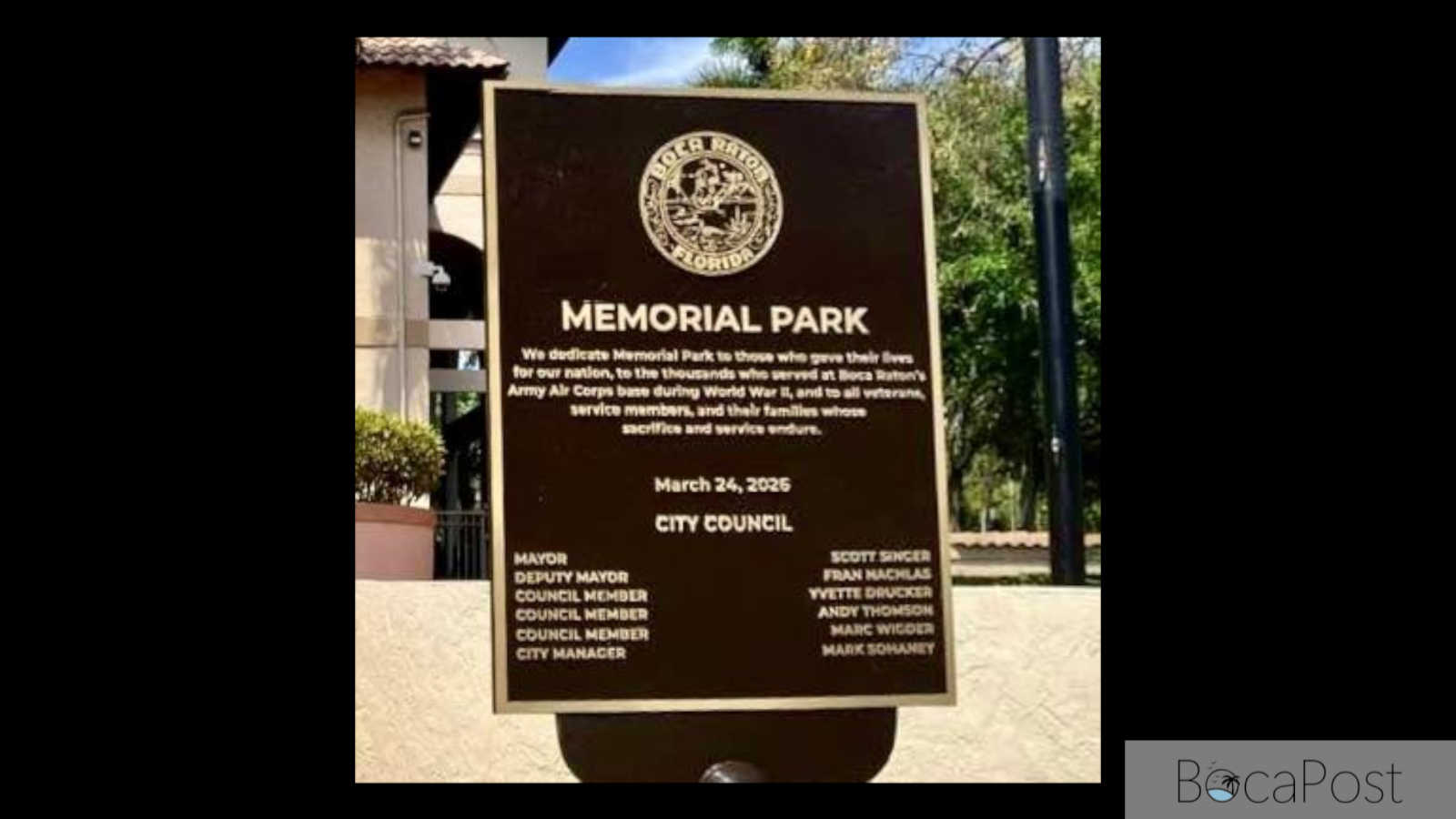
That marker states the city dedicated Memorial Park “to those who gave their lives for our nation, to the thousands who served at Boca Raton’s Army Air Corps base during World War II, and to all veterans, service members, and their families whose sacrifice and service endure.”
Criticism surfaced soon after the late March dedication ceremony. Members of the grassroots Save Boca organization objected to the plaque’s language and to the names included on it, arguing that the marker improperly credits council members who had supported development efforts involving the park and surrounding downtown land.
That criticism carried particular weight because Save Boca had opposed the city-backed development initiative tied to the property. For those residents and advocates, the issue was not just wording on a marker. It was whether the official city record at the park reflected the actual preservation fight that played out around the site.
In an April 7 memo to the council, Sohaney wrote that, at the request of several current council members, a resolution has been prepared to replace the existing plaque.
Under the proposed change, the new plaque would recognize local veterans and community advocates who worked to preserve the land from development. It would also restore historical context tied to the park’s original designation in 1947, including identifying the Town Council members who approved that designation at the time.
The revised wording would go beyond the recent dedication and place the site in its original civic and historical setting. According to the memo, the new plaque would include language noting that Memorial Park was established on April 28, 1947, in the years immediately following World War II.
The proposal would also acknowledge more recent public involvement, specifically civic engagement by residents during 2025 and 2026 to protect the park. That addition would formally recognize the local organizing and public opposition that became part of the park’s modern history.
Responsibility for the decision now sits with the Boca Raton City Council, which will decide whether to approve the resolution and authorize the removal and replacement of the current marker. If the measure passes, the plaque now installed at Memorial Park would be removed and replaced with one that aligns with the city’s new resolution.
What happens next is straightforward. Council members will consider whether the city should revise the memorial language, the historical framing, and the list of people recognized at the site. A vote in favor would set the replacement in motion and settle, at least officially, how the city intends to present Memorial Park’s story.
For residents, the issue is larger than a plaque. It is about how Boca Raton records public memory at a site tied both to military service and to a recent local fight over land use, preservation, and civic pressure. The upcoming council action will determine whether the city keeps the current wording or adopts a version that places Memorial Park back in its 1947 context while also recognizing the residents and advocates who fought to keep it intact nearly 80 years later.
Boca Post publishes Boca Raton News with a local-first focus—covering everything from city hall to the streets where people live and work.